Stop 2 of 14
What is Alzheimer's disease?
Helpful to know first: What is dementia?
The Short Answer
Alzheimer's disease is a specific brain disease and the most common cause of dementia. It involves characteristic biological changes in the brain that develop slowly over time.
Understand It
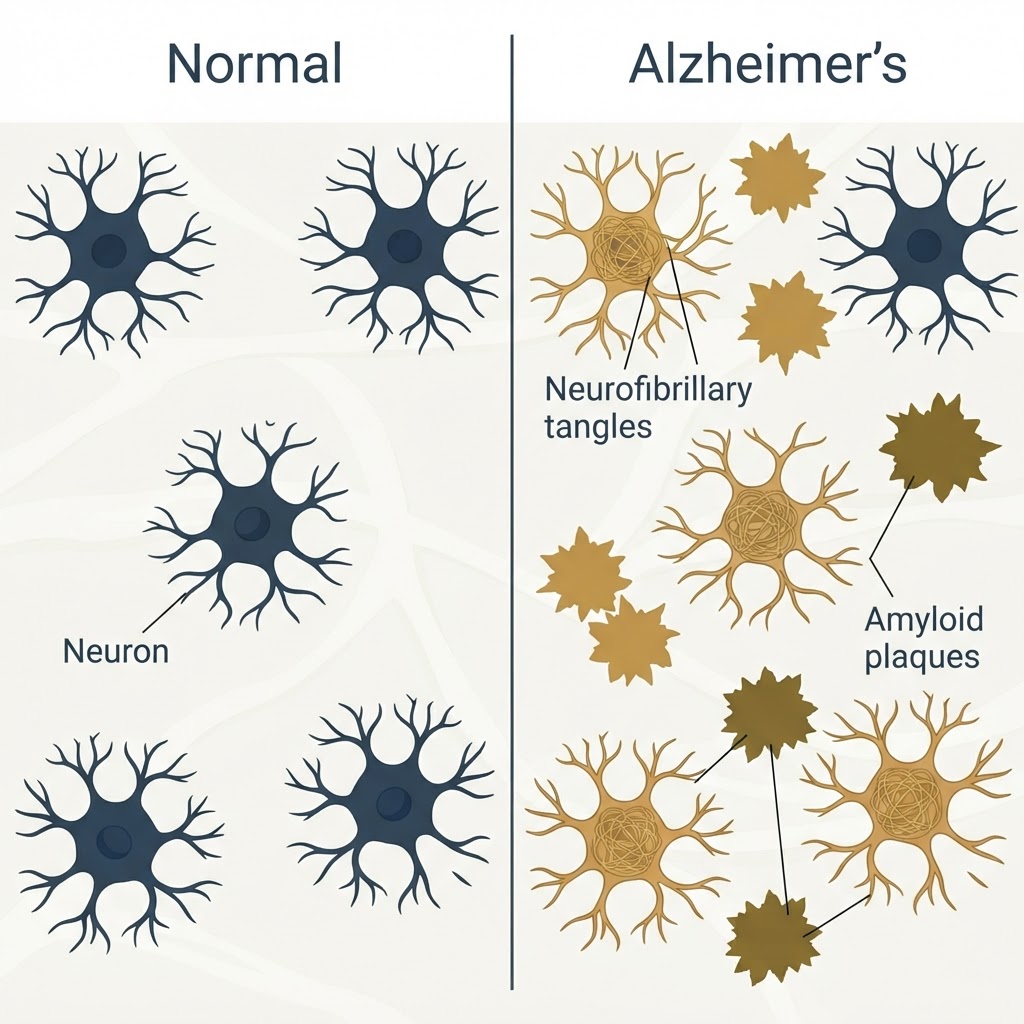
Alzheimer's is a specific disease, not just another word for dementia. While dementia describes a pattern of symptoms, Alzheimer's disease describes the underlying biology causing those symptoms.
The brain of a person with Alzheimer's disease develops two hallmark changes:
- Amyloid plaques — clumps of a protein fragment called amyloid-beta that accumulate between nerve cells
- Tau tangles — twisted strands of a protein called tau that accumulate inside nerve cells
These changes develop slowly, often over many years, before any symptoms appear. As the disease progresses, nerve cells lose connections and eventually die, leading to the symptoms we recognize as dementia.
Key distinction: Alzheimer's disease is the biology. Dementia is the clinical picture that can result from that biology. A person can have Alzheimer's biology without yet having dementia symptoms.
Watch: A Brief Overview
Quick Check
A moment to check your understanding — this is feedback, not a test.
Can a person have Alzheimer's disease biology without having dementia?
Could you explain this to someone else?
Could you explain why finding amyloid in the brain isn't automatically the same thing as having dementia?
The One Thing to Remember
Alzheimer's disease is a specific biological disease — dementia is the pattern of symptoms it can cause.