Can You Have Alzheimer's Without Dementia?

In our last article, we established a mental model for navigating cognitive care:
Dementia = Dog
Dementia due to Alzheimer’s disease = Golden Retriever
Every Golden Retriever is a dog, but not every dog is a Golden Retriever. Dementia describes how someone is doing functionally in daily life, while Alzheimer’s describes the specific biological disease process causing it.
That rule clears up a lot of initial confusion. But it leads to another question that patients and families ask more and more often:
Can someone actually have Alzheimer’s disease without having dementia?
To answer that, we just have to look at the life of a Golden Retriever.
The Golden Retriever Continuum
A Golden Retriever doesn’t suddenly become a Golden Retriever on its second birthday when it reaches full size.
A 10-week-old Golden Retriever puppy is still a Golden Retriever. It may look and behave very differently than it will at eight years old, but it didn’t become a Golden Retriever somewhere along the way.
Alzheimer’s disease works similarly in one important way: the disease can be present long before someone develops dementia.
Like any analogy, this isn’t meant to predict what will happen to an individual person or how quickly they may progress. It’s simply a way to understand how the same underlying disease can look different at different clinical stages.
The Same Disease Can Look Very Different Over Time
Thanks to advances in biomarker testing—including blood tests, CSF testing, and PET imaging—we can now detect the biological signs of Alzheimer’s disease before someone develops dementia, and even before noticeable cognitive symptoms appear.1
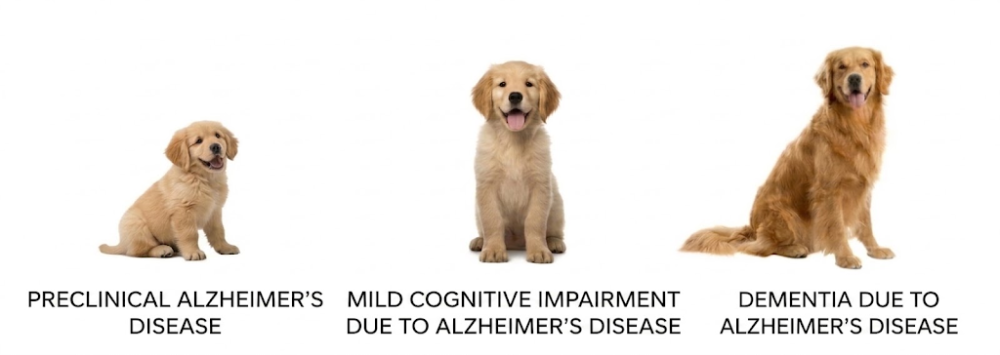
Alzheimer’s can look very different depending on where someone is along that continuum:1,2
• Preclinical Alzheimer’s Disease — The “Puppy” Stage
Alzheimer’s biology is present in the brain, but the person does not have noticeable cognitive symptoms. Under the 2024 Alzheimer’s Association criteria, disease-specific biomarkers can establish Alzheimer’s disease even when someone is cognitively unimpaired.
• Mild Cognitive Impairment (MCI) due to Alzheimer’s Disease — The “Adolescent” Stage
Measurable changes in memory or thinking are now present, but overall independence is preserved. Managing complex tasks like balancing finances or learning new routines might require extra effort or workarounds, but day-to-day life carries on independently.
• Dementia due to Alzheimer’s Disease — The “Full-Grown” Stage
Cognitive impairment has progressed to the point where it directly interferes with daily independence.
Why This Distinction Matters
For decades, the standard saying was: “All Alzheimer’s is dementia, but not all dementia is Alzheimer’s.”
With what we now know about the biology of Alzheimer’s disease, that old saying doesn’t quite work anymore.1
We now know that someone can have Alzheimer’s disease without having dementia.
The disease didn’t suddenly appear the moment daily independence was impacted—just like a dog doesn’t suddenly become a Golden Retriever when it grows up. The Golden Retriever was there all along.
The Bottom Line
Understanding this continuum helps demystify why two people with an “Alzheimer’s” diagnosis can look completely different.
One person may still be living independently and managing most aspects of daily life, while another may need around-the-clock care. Both can have Alzheimer’s disease—they are at very different points along the clinical path.
When families understand where their loved one sits on that continuum, it takes away some of the mystery—and makes it easier to understand what comes next.
The important thing to remember is this: a Golden Retriever puppy is already a Golden Retriever. And someone can have Alzheimer’s disease before they have dementia.
References
- Jack CR Jr, Andrews JS, Beach TG, et al. Revised criteria for diagnosis and staging of Alzheimer’s disease: Alzheimer’s Association Workgroup. Alzheimers Dement. 2024;20(8):5143-5169. doi:10.1002/alz.13859
- Dickerson BC, Atri A, Clevenger C, et al. The Alzheimer’s Association clinical practice guideline for the Diagnostic Evaluation, Testing, Counseling, and Disclosure of Suspected Alzheimer’s Disease and Related Disorders (DETeCD-ADRD): Executive summary of recommendations for specialty care. Alzheimers Dement. 2025;21(1):e14337. doi:10.1002/alz.14337
Get new articles in your inbox
Join readers who want clarity on dementia research — without having to read the journals themselves.
This article is provided for informational and educational purposes only and does not constitute medical advice. Always consult a qualified healthcare professional for questions about diagnosis, treatment, or your personal health.
Jennifer West, DMSc, PA-C
Dementia-focused clinician, clinical investigator, and Certified Dementia Practitioner with over a decade of experience in neurodegenerative disease research and patient care. Her doctoral work focused on biomarker-informed approaches to the dementia workup in primary care. Read more about Jennifer →